The List
Sign up. Perform. Next.
A free QR-code sign-up board for restaurants, open mics, karaoke nights and walk-in queues — anywhere order matters. Customers and performers scan a QR, you get a live running order. No account. No app.
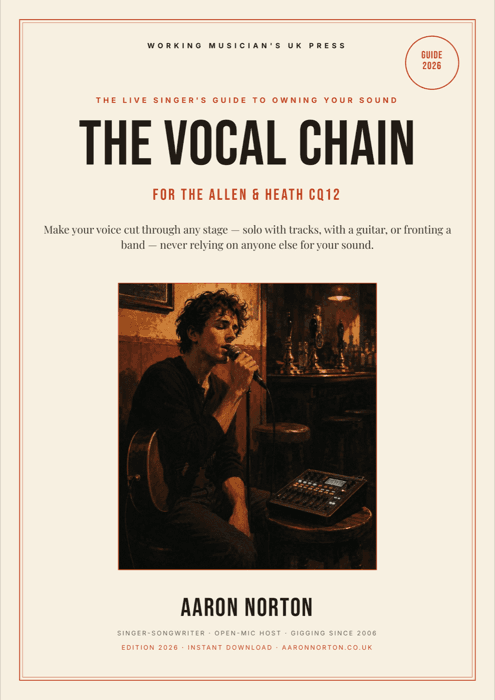
PDF guide · live vocals
Crystal-clear vocals, every gig
The essential guide to dialling in live vocals — clean gain, zero feedback, a voice that cuts through any room. If you run the sound at an open mic, this is the one. Written by a gigging musician who plays 300+ shows a year.
Start free — get the cheat sheet →↓ Keep scrolling — see everything The List does
What are you running?
One engine. Four ways to use it.
Open mic night
Fair slots, live running order, no clipboard.
Learn more →
Karaoke
Two songs each. Singers add themselves. You run the mic.
Learn more →
Comedy night
Fair sets for every comic. No whiteboard, no drama.
Learn more →
Restaurant waitlist
Walk-in queue for restaurants, bars, barbers, chip shops, clinics.
Learn more →
How it works
Pick your event
Choose a preset or tweak the defaults. Takes 10 seconds.
Share the QR
Stick it on the door, project it on a screen, or drop the link into a group chat.
Run the night
Sign-ups stream in live. You reorder, randomise, or just call names in order.
Why it's different
Most sign-up tools want you to create an account, invite performers, verify emails, set up a team workspace. The List does none of that. Possession of the admin URL is the authorisation. Anyone who holds the link runs the event.
Performers never see an account wall. They scan a QR and they're in the list. The data vanishes 48 hours after the night — nothing long-lived, nothing to manage, no emails the next morning.
Performers don't just sign up and wait. Each one gets their own live page — a pie wheel showing the whole running order, a countdown to start time, and their slot pulsing pink when they're up. One tap Done on your side advances everyone, and auto-advance kicks in if you forget. Late arrivals can still be added as walk-ins without breaking the order.
Stop managing the clipboard.
Free, anonymous, no account, no app. Your next event is 10 seconds away.
The Live Scene — Latest
Open mics, grassroots venues and the state of live music. Our take, with a link to the source.
A pilot matched just 21% of live audio in grassroots venues to registered songs. Now 108 UK venues are being measured until December
Music Venue Trust and Audoo put listening meters on the mixing desk in a handful of small venues over August and September, and NME reports that only 134 of 623 hours of live audio matched songs registered with PRS for Music. MVT says the rest isn't all unregistered, since it includes talk between songs and anything the tech missed, and PRS says the method isn't yet proven on live sets full of new material. Our take: the rooms on The List are where unreleased songs get a first airing (87% of the songs recognised in September were heard only once), so the 108-venue study running until December could change how royalties from those nights are shared out.
A new 450-cap grassroots room has opened in Manchester: Locker launched downstairs at New Century on 2 October
Hits Radio reports that Locker opened on 2 October on the ground floor of New Century, a 450-capacity live-and-club space whose manager Andrew Devine says is "about growing bands and showing bands off". New Century's MD Abby Mudge told Manchester Confidentials back in May that the point of the rebuild was to make more room for emerging artists and promoters. Our take: most of this year's venue news has been closures and rates relief, so a city-centre operator choosing to build a smaller room on purpose is worth noting, and it's exactly the kind of place The List exists to point you at.
A free print gig magazine lands in 500 UK venues from November: 50,000 copies of Shownotes, backed by Music Venue Trust
Press Gazette reports that Drowned In Sound is putting its first print title, Shownotes, into more than 500 live music venues from November, 50,000 free copies a quarter, with Music Venue Trust behind the distribution. It is built around the live experience, with gig recommendations and interviews meant to send readers out to their local scene. Our take is that it is a good sign when someone bets on print to get people through venue doors. What a quarterly can't carry is what's on this Thursday, and that week-to-week picture is the bit we keep working on.
Wales is making its rates cut permanent: 30% off for pubs, bars and live music venues from April 2027
The Welsh Government says pubs, bars, licensed clubs and live music venues with a rateable value under £51,000 will get a permanent 30% cut in business rates from 1 April 2027, up from the 15% temporary relief they get now. It still has to go through the Senedd this autumn. Our take: most of the open mics in Wales run in exactly these rooms, and a cut a landlord can actually plan around does more to keep a weekly music night going than another one-year reprieve.
New Scottish research finds a "missing middle" — plenty of open mics, but a quarter of acts see no route to paid work
Chortle reports on research by Brass Tacks Comedy, funded by the Scottish Government, in which almost a quarter of the 77 respondents described an insurmountable barrier between open-mic spots and paid work, with the obstacles most often named being access to industry contacts (66%) and getting gigs or approaching bookers (65%). The authors call it a missing middle, and note that what people actually praised was the abundance of open mics themselves. Our take: it is a comedy study, but the shape of it is familiar in music too — the stage time is out there, and the hard part is knowing which rooms are on and who books them.
Fender and Music Venue Trust want fans to nominate their local venue — three win a full backline, nominations close 1 October
NME reports that Fender, working with Music Venue Trust, is asking fans across England, Scotland and Wales to nominate their favourite grassroots venue, with one winner per region taking a gear bundle of amps, a 5150 combo and a digital console sized to the room, and nominations open until 1 October. MVT chief operating officer Beverley Whitrick said grassroots venues cannot keep being expected to survive on goodwill and admiration alone. Our take: the rooms that get nominated are usually the ones quietly running a weekly open mic for no money, and a better desk in a room like that is felt by everyone who plugs into it.
Developers will have to prove a pub is finished before turning it into flats — England's new rules cover around 30,000 pubs
The Morning Advertiser reports that England's updated National Planning Policy Framework will make developers prove a pub has no viable trading prospects — including evidence it was marketed for sale for at least 12 months — before it can be converted, with councils also weighing whether losing it would strip a community of a gathering place. Around 30,000 pubs are covered; UKHospitality's Allen Simpson said the bigger issue is the costs pushing pubs out of business in the first place. Our take: most weekly open mics live in a pub back room rather than a dedicated music venue, so a rule that makes those rooms harder to lose protects a lot of stage time nobody counts.
Oxford has put £20,000 behind its own music scene — two venue grants and around ten for musicians and promoters
Oxford City Council opened applications on 17 August for a £20,000 Grassroots Music Fund, split into two £5,000 grants for venues and roughly ten averaging £1,000 for musicians and promoters, with a deadline of 9am on 12 October. Councillor James Taylor, the council's events, live music and nighttime economy champion, said the fund will help local musicians, venues, promoters and anyone who loves live music. Our take: most of the money aimed at grassroots music is national and slow to arrive, so a city funding its own scene directly is worth watching. The nights it pays for are exactly the small local ones nobody hears about until someone lists them.
A Reigate bar has cancelled all its live music after a council noise notice — 20 years of gigs, stopped by one complaint
The Morning Advertiser reports that The Cage in Reigate has cancelled all live music after Reigate & Banstead Borough Council served a noise abatement notice on 5 August, ending a run of more than 20 years. Owner Adrian Rothera said the venue will not survive as a hospitality business without it; the council said the notice does not prohibit live music and that stopping it was the business's decision. A petition backing the gigs has passed 9,000 signatures. Our take: a live night usually ends this way, not through a bad turnout but a notice through the door — which is why a listing can be right one week and wrong the next.
A 20% business rates cut for pubs, clubs and live music venues, but not until April 2027
The Press Association reports that the Prime Minister confirmed on 23 July a 20% business rates cut for pubs, social clubs and live music venues in England from April 2027, covering nearly 32,000 businesses and worth around £1,100 a year to a typical pub. The very largest live music venues are excluded, and Music Venue Trust called it an encouraging first step. Our take: most weekly open mics happen in pubs and social clubs rather than dedicated venues, so this lands where grassroots stage time actually is. The catch is the date. April 2027 is a long way off for a room deciding this autumn whether to keep its night on.
Ten grassroots venues are now community-owned — Brighton's The Pipeline is the latest to come off the property market
CelebrityAccess reports that Music Venue Properties has bought the building housing The Pipeline in Brighton — its tenth venue under the Own Our Venues scheme, funded by around £7m from 2,500-plus small investors since 2022 and leased back to operators on secure rents. The Pipeline's Thomas Evrenos said knowing the building is now secured means they can focus on what matters most. Our take: venues rarely stop putting on live nights because nobody came — they stop because the lease went, so ten rooms just got much harder to lose, and the open mics inside them with them.
Music Venue Trust reopens its Liveline fund — it will underwrite up to 80% of the losses on a show
Music Venue Trust opened applications on 21 July for its Liveline fund, open to venues, promoters, bookers and artists. Event Industry News reports four funding streams, including a guarantorship underwriting up to 80% of approved losses on eligible shows, paid for in part by Coldplay giving 10% of the proceeds from their 2025 UK stadium tour. MVT chief executive Mark Davyd said the collapse of touring across the UK needs a coordinated response from everyone involved in booking shows. Our take: a town usually loses its live nights because nobody can afford the risk of putting one on. Take the risk away and the nights come back — and then people have to be able to find them.
2,000 artists across 400 grassroots venues in one weekend — the circuit filled the gap Glastonbury left
Pollstar reports that more than 2,000 artists played over 400 grassroots venues across the UK from 26-28 June, on the weekend Glastonbury would normally have taken, with Music Venue Trust's Mark Davyd calling it a vote of confidence from communities all over the country. Our take: the rooms and the audiences are already there. What is usually missing is knowing which local night is actually on, and when — which is the bit we are trying to fix.
Open mic isn't just an acoustic guitar any more — electronic open mics now run in 15+ UK towns
EMOM (Electronic Music Open Mic) has grown from a 2017 experiment into a circuit covering Birmingham, Nottingham, Swansea, Bournemouth and a dozen more, with 15-minute first-come slots for anyone with a laptop or a synth. More kinds of stage time is good news for everyone — more nights worth showing up for.
Some good news for the circuit: the £1-a-ticket arena levy is reaching small venues
The Music Venue Trust says 2026 brings Grassroots Levy money — £1 from arena and stadium tickets — into small venues, plus £2m of its own to keep them open. A healthier grassroots scene means more open mics and more rooms to play. Worth knowing which of your locals benefit.
175 UK towns have lost their regular live shows — the grassroots circuit is fragile
The Music Venue Trust's latest report is stark: 30 grassroots venues shut last year and 175 towns no longer get regular touring shows. For anyone playing the circuit, knowing where the live nights actually still are matters more than ever — which is the whole point of The List.