Free tool
Open mic running order generator
Enter performer names and your night length. Get a fair running order with slot times you can print or paste into your phone.
Inputs
Prefer to paste names below? This updates automatically.
Gross minutes available between doors and closing.
Two halves with a break in the middle is the classic open mic shape.
Fill in HH:MM and slots show as clock times. Leave blank and they show as +15m, +30m, etc.
Leave blank to use placeholder names. The “how many” number above drives the count when this is empty.
Plan summary
8 on the lineup
2 halves of 60 min each
Half 1: 15 min per performer
Half 2: 15 min per performer
Or: skip the maths entirely
Use The List to run the whole night: performers scan a QR and sign themselves up, you see the live running order and these exact slot times on your phone. Free. 10 seconds to start.
Running order
| # | Performer | Half | Starts | Slot | Songs |
|---|---|---|---|---|---|
| 1 | Sarah | H1 | start | 15 min | ~2 |
| 2 | Jen | H1 | +15m | 15 min | ~2 |
| 3 | Priya | H1 | +30m | 15 min | ~2 |
| 4 | Dan | H1 | +45m | 15 min | ~2 |
| 5 | Mike | H2 | +1h | 15 min | ~2 |
| 6 | Tom | H2 | +1h 15m | 15 min | ~2 |
| 7 | Alex | H2 | +1h 30m | 15 min | ~2 |
| 8 | Heidi | H2 | +1h 45m | 15 min | ~2 |
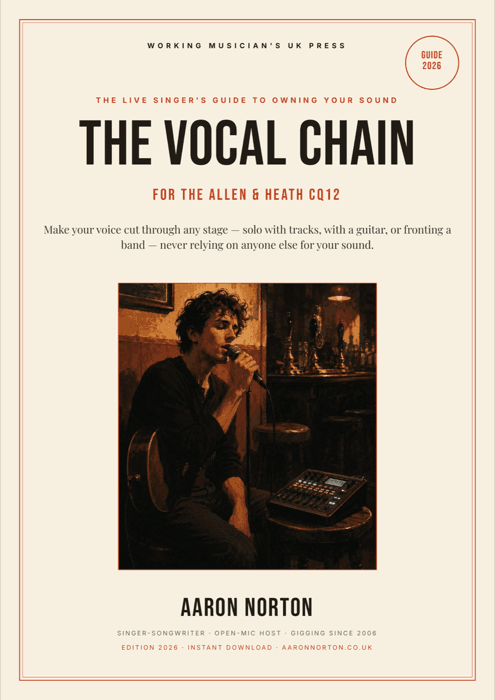
PDF guide · live vocals
Crystal-clear vocals, every gig
The essential guide to dialling in live vocals — clean gain, zero feedback, a voice that cuts through any room. If you run the sound at an open mic, this is the one. Written by a gigging musician who plays 300+ shows a year.
Start free — get the cheat sheet →How the maths works
A two-hour open mic with eight performers isn't eight fifteen-minute slots — there's an interval, sound-check overhead, a closing set, and the first ten minutes of people wandering in. In practice you've got more like 90-100 minutes of real stage time, split across two halves with a break in the middle.
This generator divides your total minutes across the number of halves you choose, then divides each half's time across the performers in that half. Fair by default. Proportional when someone joins late. It also suggests how many songs each performer can fit at a given slot length (roughly 4 minutes per song, which is a sensible default for acoustic nights).
If you'd rather not manage the list on paper, use The List — same slot maths, but performers add themselves by scanning a QR code, and the running order updates live as they do. Free. No sign-up. 10 seconds to set up.
FAQ
How do you run an open mic night?
Pick a start and finish time, decide how many songs each performer gets (two is the usual at an acoustic night, three if it's quiet), and split the night into two halves with a short break in the middle. Take sign-ups as people arrive, then set slot lengths from how many names you've got and how much stage time is left. The fiddly part is the maths — and it changes every time someone new walks in. That's exactly why I built The List: performers scan a QR to add themselves and the running order recalculates live, so you can host the night instead of doing sums on a beer mat.
How do I make an open mic sign-up sheet?
The old way is a clipboard by the door with numbered lines — it works, but you still have to copy it into a running order and redo the timings every time the lineup changes. The faster way: print one QR code, stick it on the door, and let performers add their own name and songs from their phone. The List does exactly that — it builds the sign-up sheet and the timed running order at the same time, and updates both as people sign up. Nothing for them to download.
How long should each open mic slot be?
Two to three songs is the fair standard — roughly 10 to 15 minutes a performer at an acoustic night. Work back from your total: a two-hour night with a break is about 90–100 minutes of real stage time, so eight performers lands around 12 minutes each. Fewer names, longer slots; more names, shorter. Use the generator above for the exact times in seconds, or let The List keep them fair automatically as the lineup grows.
How does the running order generator calculate slot times?
It takes your total night length, splits it into halves, and divides each half's available stage time across the performers in that half. 60 minutes and 4 performers = 15-minute slots. Add a 5th, everyone drops to 12 minutes. The maths stays fair automatically.
What happens if too many performers are added?
The tool enforces a 5-minute minimum slot so you can't accidentally give everyone 90 seconds. If you push past the cap, the overflow is flagged with a warning — you then decide whether to extend the night, reduce slots further, or cap the lineup.
Can I use this for comedy nights or karaoke?
This page is tuned for open mic (2-3 songs per slot, halves, interval). For karaoke or comedy, use The List's karaoke preset (fixed slots per singer) or comedy preset (set-notes field + lottery randomise).
Is there a limit on how many performers I can add?
The form accepts up to 60 names at once. In practice the 5-minute minimum slot length is the real limit — a 2-hour single-half night caps at 24 performers before the tool warns about overflow.
Can I save the running order?
Tap Copy as text to paste it into Notes or Messages, or tap Print / PDF to save a printable copy. For a live running order that updates as performers actually sign up, use The List — same slot maths, but performers add themselves via a QR code.
Is this free? Is there a catch?
Free. No sign-up. The whole calculation runs in your browser — nothing is sent to a server, nothing is stored. The page carries no ads. The main tool (The List) is free too.
Want to skip the paper list entirely?
The List runs this exact calculation live — performers scan a QR, sign themselves up, and the running order updates on your phone.
Start an open mic →